
 Well, that took a bit — due almost exclusively to the likely professional misconduct of Trump controlled counsel Sarah Fabian — but the solitary confinement of children in private, for profit (likely Trump donor controlled), unlicensed facilities… is at an end.
The able USDC Judge Gee ordered it (18 pages) effective immediately — with a stay to September 15, 2020 — thus:
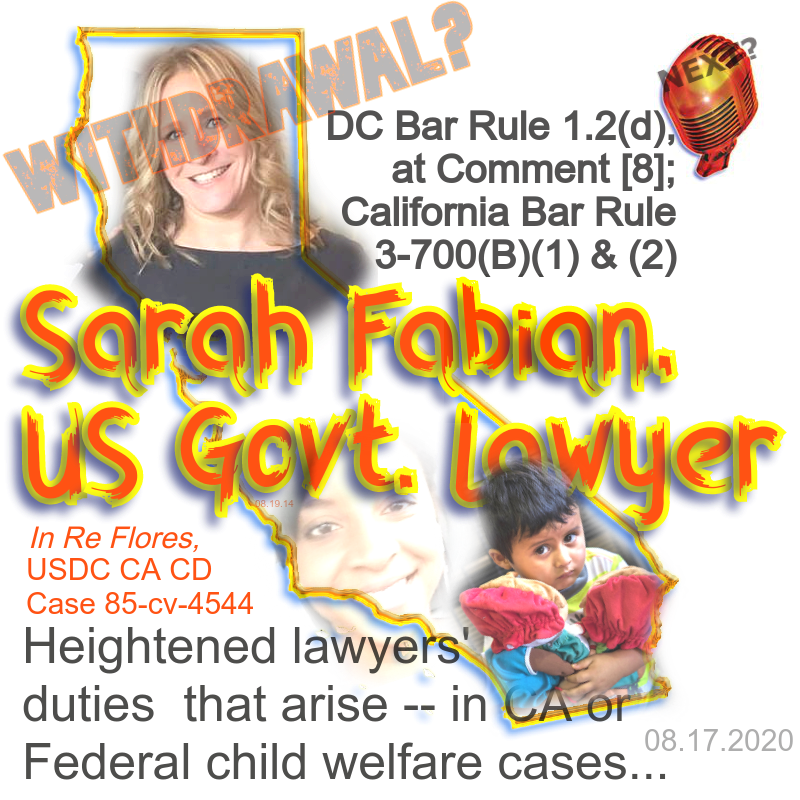 …[M]ultiple legal services providers attest that DHS summarily re-designates minors from Title 42 to Title 8 custody, with no explanation given, and perhaps for no other reason than that counsel has appeared to advocate on the child’s behalf. See Nagda Decl. at ¶ 32 [Doc. # 920-4] (“We are not aware of any reason for the children’s ‘re-designation’ other than our efforts to notify DHS that we were aware of the child’s presence in DHS custody.”); Galindo Decl. at ¶ 5 [Doc. # 897-3] (“[E]very time we have contacted the government about a specific child who had not yet been removed, the government has removed that child from the Title 42 Process.”); Odom Decl. at ¶ 19 [Doc. # 920-3] (“In almost every case, our intervention has succeeded in officials reprocessing the children under Title 8, rather than Title 42[.]”); Galindo Decl. at ¶ 3 [Doc. # 920-7] (“As of August 13, 2020, the U.S. government has transferred at least 44 unaccompanied children out of the Title 42 process and into ORR care as a result of our efforts.”).5 CDC appears to have no role in this process. See Nagda Decl. at ¶ 33 (“[W]e have never interacted with a CDC representative in any capacity[.]”); Seaton Decl. at ¶ 16 [Doc. # 920-5] (“I did not interact or communicate with any representatives from the CDC during my representation of [a minor in Title 42 custody].”). In July 2020, 46 minors were reprocessed from Title 42 to Title 8 custody….
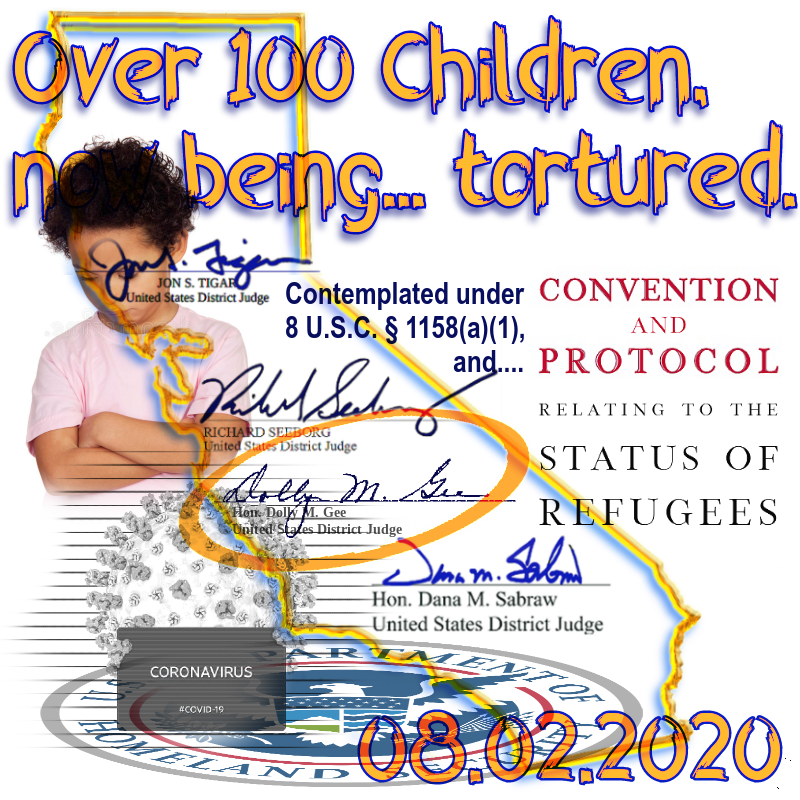 DHS also has complete control over where and under what conditions to detain minors under Title 42, including over the decision to house them in hotels. The hoteling operation is managed by the Juvenile and Family Residential Management Unit of ICE, which has hired a contractor to run the facilities on the ground, though ICE “oversees all aspects of the operations.” See Harper Decl. at ¶¶ 1–3, 11 [Doc. # 925-1]. CDC appears to have no role in the process. See id. ICE feeds, clothes, and provides for the hygiene of the minors, with apparently no input from CDC. See id. at ¶¶ 13–18. ICE even handles medical care for the minors, see id. at ¶ 20, notwithstanding CDC and HHS’s expertise in the field. In other words, DHS maintains “the right and the responsibility to make the decisions relating to the health, education, and welfare of [the] child.” Cal. Fam. Code §§ 3003, 3006 (definition of legal custody in the family law context).
Finally, DHS has wide discretion to determine when and whether minors held under Title 42 leave their custody. According to the Independent Monitor, the amount of time minors spend in hotels under Title 42 custody varies widely, with no apparent methodology and no formal limits on the length of stays. August 26 Interim Report at 16–19. There is no indication that CDC plays any role in deciding when minors’ custody with DHS ends and they are ultimately expelled from the country. DHS retains plenary authority to make this “major decision” affecting the child’s life….
The Flores Agreement requires that, if there is no qualified adult or entity that can take custody, DHS must transfer the minor to a “licensed program” within three days of their arrest — or, in cases of an “emergency or influx,” “as expeditiously as possible.” FSA at ¶¶ 12, 19. Licensed programs are those that are “licensed by an appropriate State agency to provide residential, group, or foster care services for dependent children.” Id. at ¶ 6.
There is no dispute that hoteling is not a licensed program. DHS’s contractor, MVM, is not licensed by a state agency to provide care for children. The hoteling also does not meet a number of requirements of licensed programs under the Agreement, including providing an individualized needs assessment, educational services, daily outdoor activity, and counseling sessions, among others….
[T]he Court finds Defendants have materially breached their duty under Paragraphs 12 and 19 to place minors in licensed facilities as expeditiously as possible….
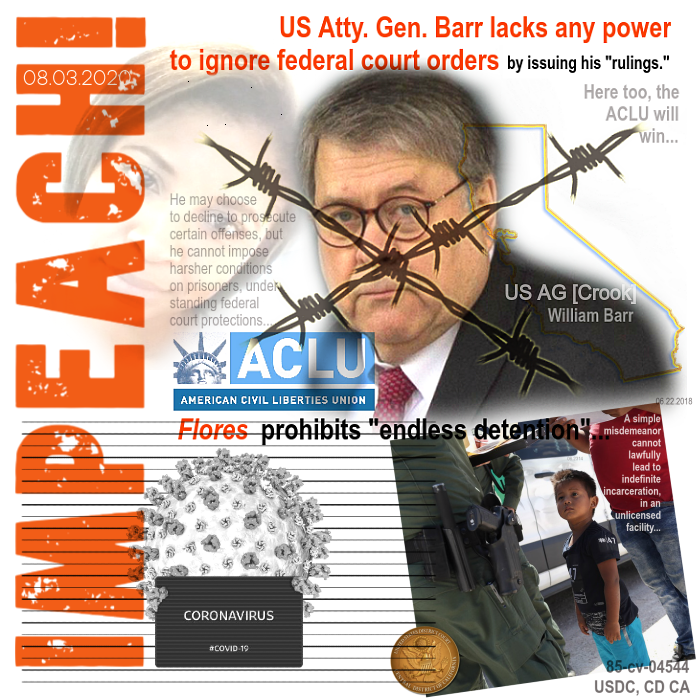 The Independent Monitor and Dr. Wise have raised concerns with this lack of qualified, specialized supervision, especially for younger, unaccompanied children. August 26 Interim Report at 19–20; July 22 Interim Report at 17, 19. The Court agrees. Children as young as 10 are left alone with an adult who has no qualifications or training in childcare. Defendants offer no formal protocols for how MVM Specialists are to adequately care for unaccompanied minors, other than vague assurances that they “interact” with the children by playing games or turning on the TV. There appear to be no separate standards for how 10-year-olds are cared for compared to 17-year-olds, despite the significant developmental differences and “particular vulnerability” of younger children. See July 22 Interim Report at 19 (“It is also important to recognize that a detention experience need not require mistreatment to be traumatic for a young child.”). Put simply, Defendants’ purported “list of amenities is not a system of care for children of different ages and developmental stages.” August 26 Interim Report at 21….
Moreover, oversight of the hoteling program is vague and minimal. MVM “quality control compliance specialists” are on site, but Defendants give no indication as to whether they have formal qualifications or follow specific procedures. See Harper Decl. at ¶ 5. ICE personnel are physically present at one hotel, and “regularly visit” the others “to ensure compliance,” but again, Defendants provide no information about their qualifications or procedures — or indeed, even what “compliance” looks like. See id. at ¶ 11. The only “independent” oversight consists of ICE’s contractor conducting “virtual” inspections, which have occurred in all three cities but not necessarily in all hotels. Defendants do not provide any details as to these inspections….
 On balance, the Court finds that the hotel program is not safe with respect to preventing minors from contracting COVID-19 or providing the type of care and supervision suitable for unaccompanied minors…
[There] is no excuse for DHS to skirt the fundamental humanitarian protections that the Flores Agreement guarantees for minors in their custody, especially when there is no persuasive evidence that hoteling is safer than licensed facilities. While the legality of the Closure Order generally is beyond the scope of this Court’s jurisdiction, the Court is obligated to ensure that minors in DHS custody are not left in a legal no-man’s land, where no enforceable standards apply. Defendants may not exploit Title 42 to send children in their legal custody “off into the night.” Flores v. Sessions, 862 F.3d at 878 n.17 (quoting Reno v. Flores, 507 U.S. 292, 295 (1993)).
In light of the foregoing, Plaintiffs’ motion to enforce the Flores Agreement is GRANTED. The Court hereby ORDERS as follows:
 1. All minors detained in the legal custody of DHS or ORR pursuant to Title 42 are Class Members as defined by Paragraph 10 of the Flores Agreement. Defendants shall comply with the Agreement with respect to such minors to the same degree as any other minors held in their custody.
2. Implementation of this Order shall be stayed until September 8, 2020. DHS shall cease placing minors at hotels by no later than September 15, 2020….
. . .Plaintiffs’ counsel shall be permitted to visit any facility where minors in Title 42 custody are held, and to meet with any minor held in Title 42 custody….
Have a safe, quiet, socially-distanced Labor Day, one and all. Sanity is making a comeback. Smiling… as seven passed, come Sunday morning….
नमस्ते
 Powerline Lies...