
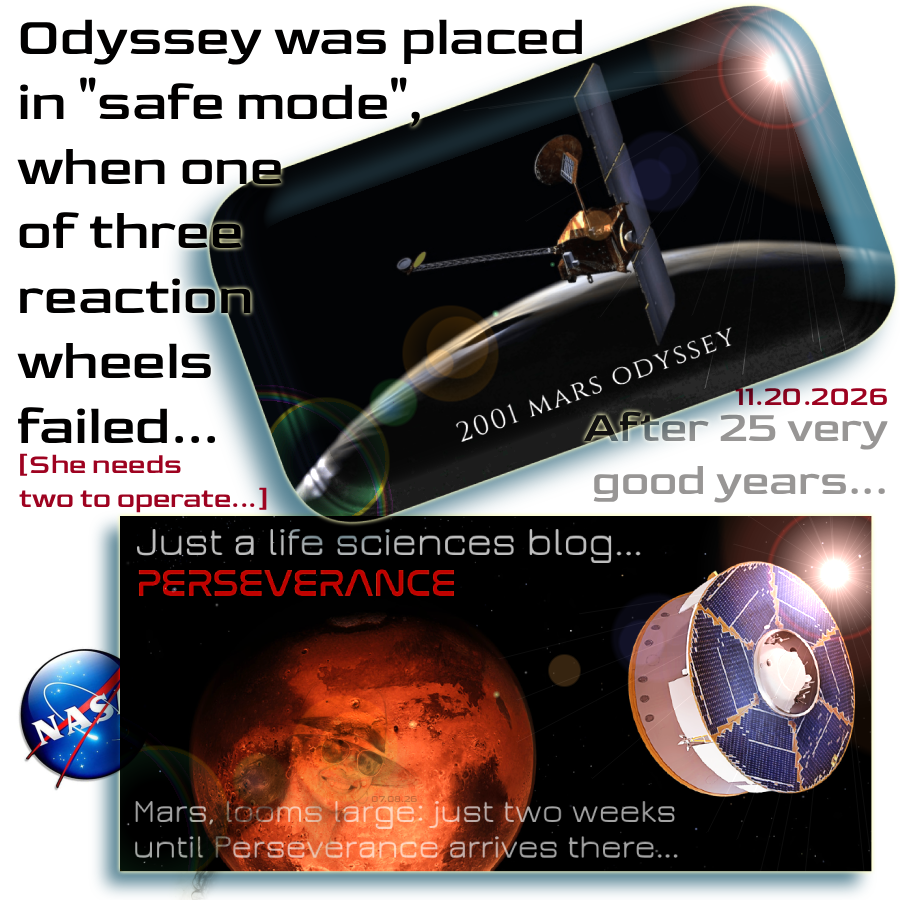
 As I said in the last one, this could well be (probably is) just some aging tech, or even mechanical system — now degraded by the batttering radiation waves, that buffet Mars. . . for a quarter-century. But it is odd. . . that the main surface rover is also showing tech issues, and it arrived in later 2020 — and so, less than six years old.
NASA bundled both these issues into a single release in a blog post — here later on a Friday night, right before the US holiday, next week. Not sure why that choice was made, by old Jared Issacman (Trump’s guy at NASA), either. Here’s the latest, in any event:
. . .[T]he 2001 Mars Odyssey mission team is investigating a malfunctioning reaction wheel on the long-running orbiter, and its science instruments are temporarily offline. Spacecraft orient themselves by using thrusters in concert with sets of reaction wheels, which speed up or slow down to change their angular momentum. Changing that momentum generates a torque that rotates the spacecraft and adjusts its angle for activities like pointing its solar arrays toward the Sun.
Between Nov. 4 and 6, the orbiter was in safe mode, which is when a spacecraft detects an issue and shuts down all non-essential systems. After investigating, engineers determined one of its reaction wheels had stopped spinning. Odyssey has four reaction wheels, one of which failed in 2013. At least three wheels are needed to help orient the spacecraft. Without the three reaction wheels, the spacecraft must rely solely on its hydrazine thrusters to remain oriented.
But the mission team estimates that, after 25 years of operation in orbit around Mars, the spacecraft only has enough hydrazine to orient itself without reaction wheels for one to two months. Efforts to refine those fuel estimates continue, as does the investigation into the malfunctioning reaction wheel. . . .
[T]he teams at NASA JPL, which leads the mission, and Lockheed Martin, which built and operate the spacecraft, continue investigating while science operations remain offline. Along with analyzing Odyssey’s data, they are running tests on the malfunctioning reaction wheel. During one test, the wheel was able to move after being commanded; further testing is being conducted to confirm whether the wheel is recoverable. The goal is for Odyssey to return to science and relay operations at the conclusion of these tests and analysis during the last week of November, and NASA will provide future updates on status and timeline as the team learns more….

Significantly, this orbiter is part of the Mars relay team that sends commands to and from the surface, and to and from Earth, when surface rover/robots are facing “away” from Earth.
 And do recall that MAVEN went 404 early in 2026, likely struck by a space-rock. So we are down to only two working relays, near Mars. So, it is very important for NASA/JPL to get this lil’ guy ship-shape, once again — if we can.
[The global Deep Space dish network can still communicate with these rovers, true — but only when the Barsoomian spot on the surface they occupy is facing Earth, and not at all — when Mars and Earth are in opposition (relative to the Sun). That is for about 25 days out of every 17 months here.]
Onward. नमस्ते

