
 This is… excellent.
Beauty on a staggeringly-vast scale. And as lethal as anything we will ever see, in the known Universe.
Take a look — via Hubble’s news release tonight:
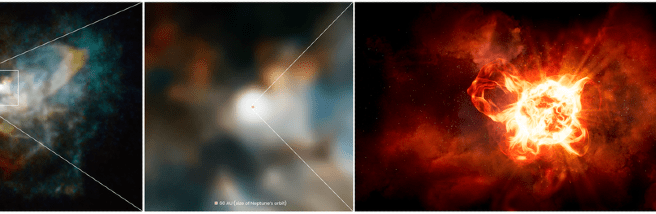
 “…The red hypergiant VY Canis Majoris — which is far larger, more massive, and more violent than Betelgeuse — experiences much longer, dimmer periods that last for years. New findings from NASA’s Hubble Space Telescope suggest the same processes that occurred on Betelgeuse are happening in this hypergiant, but on a much grander scale.
“VY Canis Majoris is behaving a lot like Betelgeuse on steroids,” explained the study’s leader, astrophysicist Roberta Humphreys of the University of Minnesota, Minneapolis….
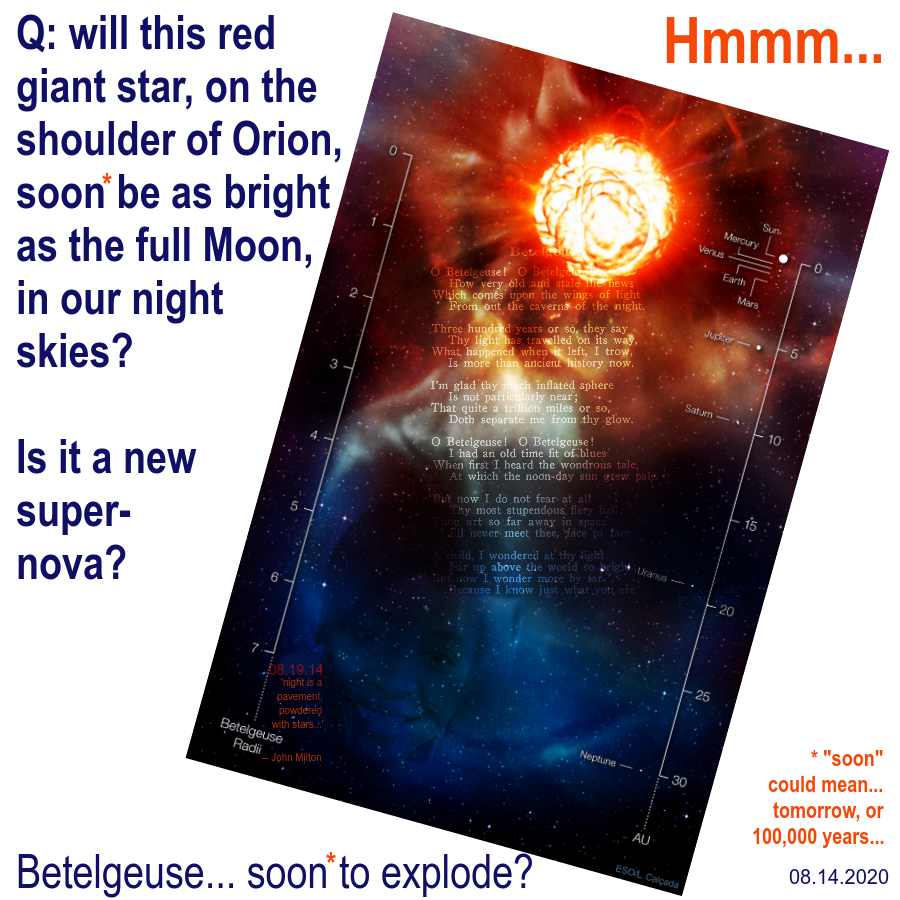
The enormous red hypergiant is 300,000 times brighter than our Sun. If it replaced the Sun in our own solar system, the bloated monster would extend out for hundreds of millions of miles, between the orbits of Jupiter and Saturn.
 “This star is absolutely amazing. It’s one of the largest stars that we know of — a very evolved, red supergiant. It has had multiple, giant eruptions,” explained Humphreys.
Giant arcs of plasma surround the star at distances from it that are thousands of times farther away than the Earth is from the Sun. These arcs look like the solar prominence from our own Sun, only on a much grander scale. Also, they’re not physically connected to the star, but rather, appear to have been thrown out and are moving away….”
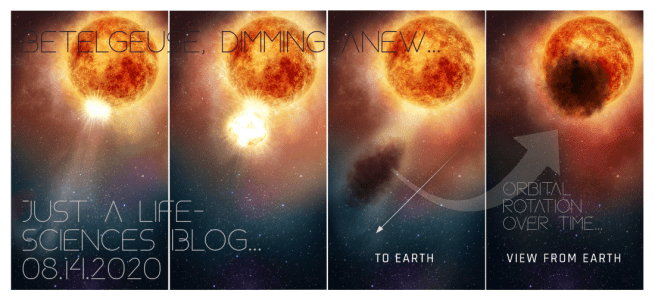
The first panel of four images, at right above is Betelgeuse. Loving this. . . simply loving it — for even as stars die, we know inexorably new ones. . . are ever being born. And, ultimately, all from the same primordial matter. Smile.
नमस्ते
 Powerline Lies...